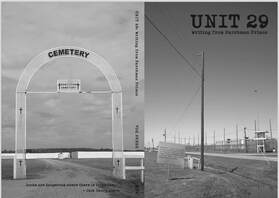
Unit 29: Writing from Parchman Prison
VOX Books.
Interview by P.B. Jernigan
I don’t remember the first time I heard about Parchman Prison. It has always existed in my memory, the heavy history looming over the entirety of Mississippi. Parchman has long influenced the creative culture of Mississippi, serving as a motif in iconic works of literature. From Mary Hamilton’s pioneer biography Trial of the Earth to William Faulkner’s The Mansion and contemporary Sing, Unburied, Sing by Jesmyn Ward– these works have immortalized Parchman’s notoriety as one of America’s most inhumane prisons. In recent years, VOX Press, through their Mississippi Prison Writers initiative, began creative writing and literature classes throughout the Mississippi prison system. VOX director Louis Bourgeois has worked with incarcerated people in workshops and writing classes since 2002. In 2024, VOX published Unit 29: Writing from Parchman Prison, compiled under the instruction of Bourgeois. It features a collection of essays, poetry, and art created by Parchman inmates.
This interview with Louis Bourgeois details the beginnings of Parchman’s creative writing classes, the process of publishing Unit 29: Writing from Parchman Prison, and the importance of platforming unheard and marginalized voices.
____________________________________________________________________________________________________________
P.B. Jernigan: What is your background working with incarcerated people, such as teaching in prisons and publishing?
Louis Bourgeois: My first experience working with the incarcerated in writing workshops began way back in 2002 at Marshall County Correctional Facility in Holly Springs, Mississippi. There was a creative writing instructor here on campus at the University of Mississippi, Gabriel Gudding, who used to teach creative writing classes at Auburn Correctional Facility in upstate New York. The history of the creative arts being taught in Mississippi prisons arguably begins with Gabe Gudding. In any case, I was finishing up graduate school at the University of Mississippi at the same time Gabe was offered a teaching post in Illinois. He didn’t want the program at MCCF to die out and he asked me if I’d take it over once he was gone. From there, it all started for me. In 2010, VOX PRESS was incorporated as a Mississippi non-profit organization for the explicit purpose of publishing marginalized writers. Our first publication was out of Parchman in 2014. Unit 29: Writing from Parchman Prison will be the 4th book from VOX’s educational outreach program, the Prison Writes Initiative.
PB: Have you published work of incarcerated people before? Have you worked with incarcerated women in the past?
LB: Yes, VOX PRESS has published 3 volumes of Mississippi inmate writing over the last 10 years; In Our Own Words, Unit 30, Mississippi Prison Writing, and Unit 29. Yes, we have worked with incarcerated female writers at Central Mississippi Correctional Facility, in Pearl, Mississippi from 2016 to right before the pandemic in 2020. Our 2021 collection, Mississippi Prison Writing, includes female inmate writing from our workshops. Yes, we will be working with the female incarcerated writers over the next couple of years.
PB: What was the purpose in publishing this collection of writings and art? What do you hope readers learn from reading this book?
LB: Excellent question. An essential question that is not so easy to respond to as one might expect. I do know that I wanted to publish a collection, particularly at Parchman, particularly from Unit 29, without literary pretensions, no niceties, but a document that goes beyond the conformities of the basic rules of what makes an acceptable story or poem. In a sense, I wanted to record human suffering as it unfolds. Extreme situations result in extreme reactions. But I’ll let the reader decide for themselves if the book is successful in rendering the accuracy of what goes on there, right under society’s nose.
PB: Tell me about reading the pieces and seeing the art. What do you think about the work the men produced?
LB: Part of this was addressed in the previous question: we wanted the reader to see reality as it relates to trying to live in the various zones of Unit 29. Most, if not all, the writers in the book had never written anything before, yet they created (over a period of 3 years) a masterpiece of prison realism. The artwork, which we had never attempted before, came from the same pedagogical principal as the writing: what would happen if you took a group of individuals, undergoing the harrowing experience of trying to stay alive in a Mississippi prison such as Parchman, with no background in the art form they were asked to engage in: what would the result be? The method to put this off was simple but potent: it doesn’t have to be good; it just has to be brutally honest.
PB: Have you been able to communicate with them about why they write, the messages of their work and what they hope to accomplish from being published?
LB: This book is the conclusion of working with over 30 inmate writers over a period of 3 years. Some of the students are still in 29, a handful were released, a great many were transferred to other facilities, and several have died since work on the collection began. Some of them from this project have in fact committed themselves to a life of writing their stories. I am still in touch with several of them in the prison and outside of it, in which we will publish their individual efforts over the course of the next few years. The whole premise of VOX PRESS is to allow the unheard to have a voice, and that is being played out now in a most meaningful way.
________________________________________________________________________________________________________________
P.B. Jernigan was born and raised in Oxford Mississippi. She is currently a sophomore in English and Southern Studies at the University of Mississippi. P.B. is interested in studying Southern culture and Southern literature. After graduation she plans on pursuing a masters degree and doctorate in English literature.