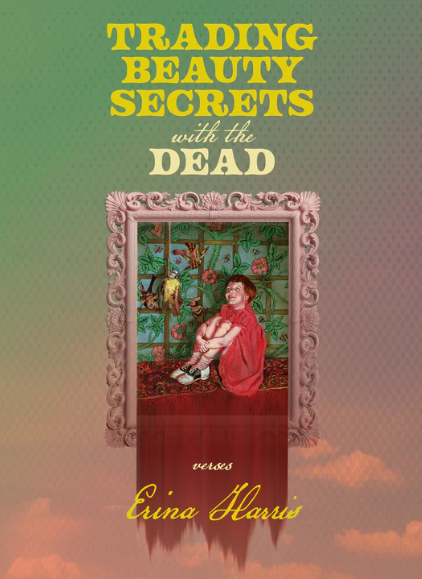
Trading Beauty Secrets with the Dead
By Erina Harris
Wolsak & Wynn, 2024
Review by Rosalie Morris
Trading Beauty Secrets with the Dead is a new collection of poetry from Edmonton-based author Erina Harris. The collection is a complex celebration of intertextuality, children’s stories, women’s work, and the concept of play. Harris takes a wide variety of figures from literature, nursery rhymes, and history. She gives them new, imagined voices that allow the reader to rethink characters who may have been with them since childhood but never earned a second thought.
Just a cursory glance at the table of contents is enough to evoke memories of childhood songs and rhymes. The poems are organized by letters of the alphabet, much like a picture book might be. In “Letter E: The Education of Little Miss Muffet,” we are given a jarring portrait of young Miss Muffet being fed spiders “crumpled onto teatime curds, or confined within / sentient globules of butter.” Harris later goes on to give the historical context that the nursery rhyme “Little Miss Muffet” was based on a real girl named Patience Mouffet, whose scientist stepfather “is said to have fed Patience spiders as a medical treatment.” This poem is just one of many examples of Harris using a known text –in this case, a beloved children’s nursery rhyme– as a foundation for a piece that explores the original work with enough depth and interest to give it an entirely new life, and its characters an interiority that has otherwise gone unexplored.
Throughout Trading Beauty Secrets with the Dead, Harris examines themes through the interplay of different literary works, myths, and historical events. She even creates some of this interplay between parts of her own book by including various types of texts. Trading Beauty Secrets with the Dead contains short verses, longer poems that read more like history lessons, and a section at the end titled “Poems: Biographies,” which includes notes on the historical context of many of the poems. Because of this, in pieces such as “Letter E: The Education of Little Miss Muffet,” the reader does not find out about the historical context of Miss Patience Mouffet until they turn to the “Biographies” section, creating a live experience of textual interplay as the reader makes their way through the book, turning back and forth between texts in order to interpret what they are reading more fully.
The most compelling writing in this collection comes in part two of the “Letter T” section, titled “Trading Beauty Secrets with the Dead: The Dolly Varden Essay,” which is itself made up of seven parts. This 65-page section contains an essay broken up into poems that deal mostly with the history of dolls and the lasting legacy of Charles Dickens’ character Dolly Varden, whose style of dress went on to spark fashion trends and grace little girls’ tea sets for years to come. The subject matter in this section feels more like something out of an academic research paper than a poetry collection, but the playful humour and singsong nature of the verse makes the complex information incredibly easy to digest as the reader trips their way through what feels like a whimsical fairytale and comes out the other side with a deep knowledge of the history of dolls, fashion, domesticity, Dickens, Stevie Smith, and the cultural impact “a fantastic, animated hat” can have. Anyone who is interested in any of these themes will find this book rewarding, whether they are poetry fans or not.
The in-depth history of Dolly Varden fashion Harris provides is relevant to today’s reader and does not feel dated. Anyone who knows a little about contemporary fashion will read about Dolly Varden dresses being “an aristocratic appropriation of the / ‘peasant’ style of dress” and immediately think of the “peasant” and “milkmaid” style dresses that are having a moment among fashion influencers today. Reading about how the Dolly Varden style made its way from aristocratic women gradually to the lower classes as “it was becoming, increasingly, / manufactured from cheaper fabrics made en masse” evokes the notorious Walmart Birkin Bag, an affordable dupe of an established status symbol, that has made headlines recently. Harris’ historical focus on fashion and its inevitable entanglement with gender roles, labour practices, and class disparity, opens up space for the reader to consider how we are still grappling with these issues and what their evolution looks like up to the current moment.
Harris makes the academic and sometimes very dark nature of her poems feel engaging through humour and playful language. We see a beautiful example of this in “III. Xenos: From the Posthumous Diaries of the Door,” where Harris writes “I am to admit Gusts and/or Guests. / I admit nothing! When a Guest / dressed best from head to toe – / To me, Mother bestowed a bark scroll”. This poem tackles the complexity of the ancient Greek concept of ‘xenos,’ which means; guest-friend, and stranger or foreigner. But the use of delightful childlike rhymes, playing with multiple meanings of the word ’admit,’ repetition, and alliteration make the poem feel easy and joyful to read. Harris adorns her razor-sharp verses with funny, playful language that takes back the concept of frivolity and uses it to encourage thought and understanding, as opposed to an imposition of intellect. Harris’ use of play, rhyme, and silliness feels much like big, delightfully adorned Dolly Varden hats sitting atop the heads of thoughtful, intriguing poems with plenty to say.
Trading Beauty Secrets with the Dead explores the idea of dolls as a blank canvas we project ourselves onto, for better or for worse, and a vessel for imagination and philosophy. Harris says, “while we waited for love or gods we talked / to dolls.” In this vein, she treats the figures from well-known books, stories, and myths as “dolls” for the reader to imagine with and through. The textual interplay throughout the work allows access to new thoughts, considers themes of identity, girlhood, womanhood, and labour, and develops complex ideas that leave the reader feeling inspired. This collection is a beautiful demonstration of Harris’ impressive capacity for intellectual depth, deft lyricism, and whimsical charm.
________________________________________________________________________________________________________________
Rosalie Morris is a writer and editor based in British Columbia. Her work can be found in The Malahat Review, Room Magazine, The Fiddlehead, Indie Is Not A Genre, and various dark corners of the internet. She is the author of Intimate Publics, a Substack newsletter about pop culture, fandom, and feelings.