“This book does remind you that even a puddle is a portal, a body of water that holds meaning, life, and an alternative universe.”
Dear Readers,
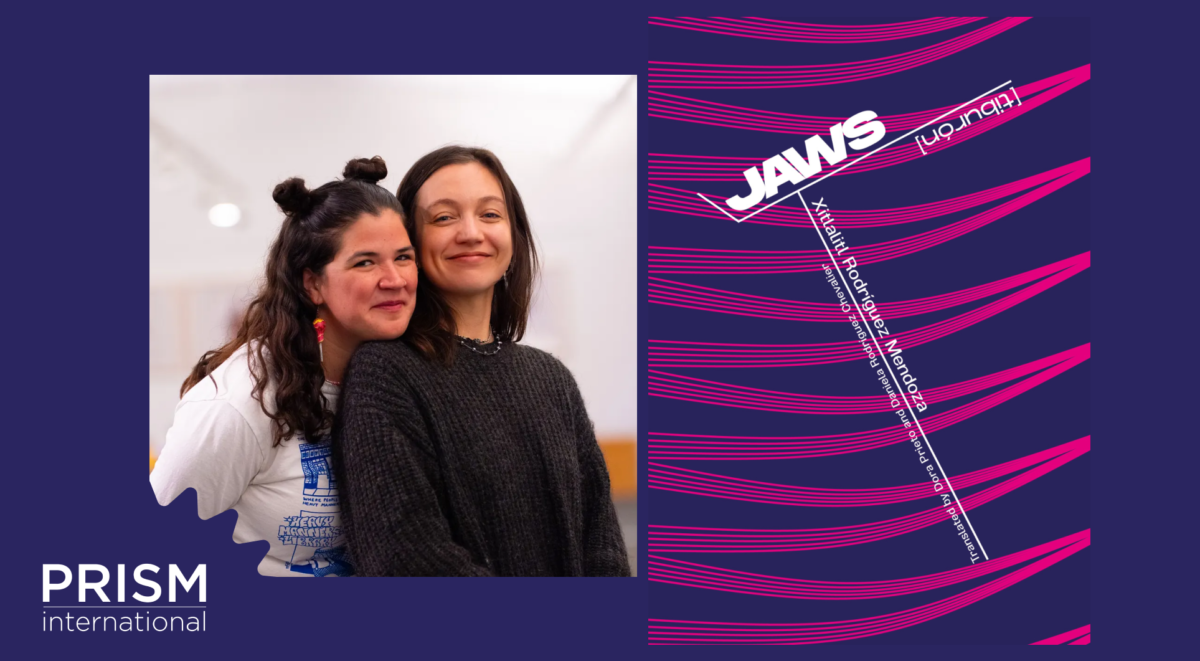
I am pleased to share this new interview with you all! Our poetry editor Ocean Wei speaks with Dora Prieto and Dani Rodríguez Chevalier about their translation of JAWS [tiburón] by Mexican poet Xitlalitl Rodríguez Mendoza. Together, they explore how to translate the untranslatable, the political dimensions of language, and the joys and challenges of collaborative translation processes.
The Green College Coach House will be hosting Dora and Dani for a cover-to-cover reading of their translation on October 15, 2026, as part of this year’s Whole Cloth Reading Series. Find more information about the event here, including a link to the event livestream.
As always, enjoy!
Sincerely,
Megan Horsthuis
Promotions Editor
Ocean: Do you want to start by saying some of your favorite and most challenging parts of translating JAWS? They can be the same or different.
Dora: One of the things that pops up a lot is the word “teeth.” In Spanish, words are more consistently Latin-rooted, and all the terminology around teeth comes from dentar or diente. English has both Latin and Germanic roots, and other random stuff through conquest, so you have to make choices. An example is, in Spanish, “ghost” is “fantasma.” In English, you have “ghost,” which is the Germanic root, and “phantom,” which is the Latin root. These decisions change the sound and connotations.
For example, in that first poem “Jaws. The movie,” there’s this moment where it says “dentar significa asirse al mundo” (14). We translated that to “to tooth means to cling to the world” (15). “Dentar” translates literally to “teethe.” But in English, “to teethe” has more of a connotation of babies teething. Because “dentar” is the Latinate version, it centers the imagery of the tooth rather than the connotation of babies. So we chose to invent the verb “to tooth.” It was one of those moments where the challenge was fun and exciting, and it ended up being one of our favorite things.
Another moment was this poem that starts in the middle of the book, starting with “Iré al grando: mi vida es dental (72).” “Dental” is a word in English, but, again, it has so much “dentist” connotation, and in Spanish, “dental” is an adjective referring to teeth. So Dani was like, what about: “my life is toothy?” There’s something silly about that, and it fits the speaker of JAWS. It was a great moment of gaining something in the translation, but it takes a lot of creativity and bravery because you’re worried about not translating well. You want to do justice to the original. But then there are these moments where doing justice to the original also requires poetic intervention.
Dani: What Dora said is part of the delightfulness of translating. JAWS is such a formally restless collection: it is polyphonic, has multiple personas, etc. It’s a testament to Sisi, the author — to her talent and her mind and heart. Also, with translation, we are thinking of the culture where the book originated, now arriving in another cultural context at a different time. As Dora said, the challenge was mostly at the line level and those untranslatable words. Also, in the parts where we couldn’t help but lose some of the poetry in Spanish. But ultimately, we gained new poetry. It was more important for us to carry the voice and the humor of this speaker that we could achieve through this toothiness than to be exact with the words, because there’s no such thing as direct equivalence.
Now, I’m reading the book, and I see wordplay that Xitlalitl did in the original. I’m like, “okay, we did something different in English.” There’s a part in one of the first poems that says “gelatin comes from there, from bone marrow, from jellyfish” (25). However, in Spanish, there’s wordplay — “la grenetina viene de ahí, de médulas óseas, de medusas” (24) — there’s more of a rhythm that we didn’t translate fully into English. But in other poems, we gained slant rhymes and other poetic moments of wonder and explosion that are so beautiful, so it’s a transformation rather than transference.
Ocean: Since the original collection already has English words, I am curious about the slippage between languages, the decisions you make around the original collection’s engagement with English content, and how the author plays with mistranslation.
Dora: One of the joys of translating this book was that it was already about language and translation and mistranslation, because even just JAWS sounding like JOS, which sounds like the plural of “I,” “Yos,” is central to the book, and a problem for translation.
English invades the Spanish text, and holds this political position of “you’re more employable if you have a high level of English…” There is no way to have English politicized in English. It’s one of those impossible things — so not a failure necessarily, just a reality. Most translations are translated into English because of colonialism and cultural hegemony. What we tried to do was let Spanish invade the English text. There is a glossary at the back that explains a couple of words we left in Spanish that are untranslatable. That felt important, not only because they are untranslatable, but also as a moment for Spanish to invade the text. If you’re bilingual, you’re gonna love this, because it’s cultural. One of them is a slang term, “caguama,” which is a one-litre bottle of beer but also means loggerhead turtle. The other one is “Itakate,” a Nahuatl word, which is the language of the Mexica, the empire in Mexico before the Spanish arrived.
We also left things in Spanish sometimes, like “Do Sharks Dream?” (41). Even though it’s translated into English, it makes sense to leave a Spanish word there; it is difficult to trace the origin of “tiburón.” Another one that comes to mind is “No alas sino aletas”, or “Not Wings but Fins” (75). We added a language lesson into the first part of that poem, so an English speaker could follow along with what we’re saying about the Spanish word, also inviting the reader to do some of that work. English and Spanish invite different politics of language to enter the text; it’s completely different when the text is in English.
Dani: You really answered the question. The book is about many things, but also about tensions between English and Spanish, and English playing a role in the sector of tourism, an employability factor in Mexico. You go to Sayulita, for example, and you see signs that say “we require a server who speaks English,” even though you’re in Mexico. Even if you only live in the Mexican world, in the Spanish world of the collection, English is present, because it’s a cultural reality. To turn these little sharks and bring them to English waters, it plays a different role in the translation, but we did try to maintain at least some sort of unsettlingness there, or make note of places where English and Spanish do something different.
Ocean: I’m curious about your thoughts on legibility. Do you feel readers who can only read in English or Spanish and readers who read in both languages get different things out of the collection? Do you have Easter eggs that only bilingual or multilingual readers will catch?
Dani: The poetry collection is a physical item, a thing you can hold in your hands. Even if you don’t understand Spanish, you can see — for example, on pages 44 and 45 — that there is another line that is missing there. Even if you don’t understand what’s on the other page, you get that something is not there. Each reader gets something different, just like I get something different from it every time I read it, even though I understand the English, the Spanish, and the spaces in between.
Argentinian writer Jorge Luis Borges always mentions that each book is different every time. JAWS will be different for readers in Spanish, for readers in English, and for readers who knew it from Spanish back in 2015 reading it now in 2026. There are new things that happened in the world, and we each bring our own personal histories and sorrows and humor, which Dora and I brought to make this happen. A reader is also creating new meanings and seeing different things depending on their background and histories, and of course, the languages they speak.
Dora: I totally agree with all of that. This collection brings what the reader brings to the work to the surface a lot. There’s a song referenced, “que me come el tiburón, mama,” which we kept in Spanish. I didn’t know that song. I think Dani did. We asked Sisi, and she showed us the song. More than being in Spanish, it’s Mexican cultural moments. There are specific language moments in which a Mexican reader will feel held.
The release event I did last night was at this Latinx bookstore in San Francisco, Medicine for Nightmares. It was a BIPOC open mic. I read a selection of JAWS. I’m located in Oakland, California, and then there’s San Francisco. The Chicanos call it San Pancho, which I love. In California, there’s so much wealth, so much tech, all of this peak capitalism happening; it’s peak and valley, because there is also so much homelessness. It used to be Mexico, and there are so many Latinos here, and yet they are systemically excluded. It’s a really intense place to be Latino.
Last night, I read one of the poems in Spanish. There were thirty people there, and maybe five people understood Spanish completely. But even Latinos who didn’t fully understand Spanish appreciated how a bilingual edition can hold them. It’s helpful to reflect on, because there are readers who maybe don’t speak Spanish, but it’s in their cultural heritage. In a bilingual edition, they can feel extra prioritized and held, too. More of a cultural than a linguistic dimension, but where these two things intersect.
Dani: That’s so beautiful. There’s also so much intertextuality within this collection. Even from Dora’s event last night, the person who works at Medicine for Nightmares messaged me later and was like, “I’m such a big fan of Jaws, the movie.” There are other points of entry for other people, even if they’re not from Mexico or are not knowledgeable or related to Mexican or Chicano culture. If they enjoyed the film Jaws, there are other avenues for them to feel connected to this collection of poems, which references many existing texts and works, not only from Mexico but also from Hollywood.
Ocean: I want to ask about your collaboration process. In the Translator’s Notes, you said having two translators empowers you to test translations and find a third, fluid translation. What is your day-to-day collaboration process like? How often do you discuss diction and sentence choice? Do you draft separately and then compare notes?
Dora: We started translating when we got a Canada Council grant, which feels important to mention because people should apply for Canada Council grants. It gives you freedom. [Without the grant], we got paid around $250 for this because of the amount of work and resources that go into making a book like this, and it’s a small press. Funding makes creative possibilities. Otherwise, I don’t think we could put in this amount of effort.
Our rhythm was that we would meet once a week for two hours. We would translate two or three poems during the week; we would do it in separate documents and bring the translated versions to our meeting to discuss. There were a lot of moments like, “I don’t really know exactly what the author means by this.” There was a lot of talking through the meaning in context; all that problem-solving we did together.
We are both bilingual, but Dani grew up in Mexico, and I grew up mostly in Canada. I consider myself bilingual, and I write in Spanish sometimes, but English is more my mother tongue. Dani has perfect English but has a deeper, cultural sense of all possible meanings of a word in Spanish, which takes a lot of familiarity with the language. Our bilingualism is so compatible.
Dani: Dora and I cofounded El Mashup, a multidisciplinary collective that started with workshops for Latino youth. Our first collaboration as artists was a 3a.m. 6mm film we did in North Vancouver. We collaborated in different aspects: not only art, but also in life and community. Each of us drafting our own version of the translation was already joyful, but coming together to make the Frankenstein third version was the most exciting part.
The book is about multiplicity: Dora and I share similar multiplicity, but also complementary ones. Thanks to the Canada Council for the Arts, we were able to dedicate the time we did, which was not the most efficient method, but where poetry lies: returning to conversations and the impulses of not fully translating directly.
Ocean: How do forms and format contribute to the thematic throughline?
Dani: The original book had a justified format for the prose poem. Our amazing editors from Cardboard House Press made incredible edits to the book not only format-wise but on the word level. They proposed not justifying the text so that we get more fluidity of the water. We are both lovers of the ocean. This book does remind you that even a puddle is a portal, a body of water that holds meaning, life, and an alternative universe.
Dora: On the topic of theme, what comes up a lot are shark hunting, shark finning, the insufficiency of international conservation, and the global dynamics of capitalism. The sharks, through the movie Jaws, were so vilified. It became a justification for hunting them because people didn’t care about sharks and were afraid of them. The whole thing around the psychology of conservation and what was considered a cute, fluffy animal that receives funding for conservation.
Dani: Central to the collection was the shark: not as monster but as mirror. JAWS says, “something in my name turns me into a fish under attack.” Sharks are incredible. They have been here for so long; they are also a species at risk. There is also labour, general workplace language, and economic terms. It was important to Sisi to maintain in English the tension between the natural world — this oceanic bloom and wonder — and, at the same time, discourses on liquidation, being employable, and having the pain and sorrow of a worker in day-to-day life; how the capitalistic world presses on the body and deems certain life expendable. Having to work to earn money and put food on the table and trying to maintain hope, dreams, and connections to one another.
Dora Prieto is a Mexican-Canadian poet, translator, educator, and community arts organizer. She is currently a Wallace Stegner Fellow in Poetry at Stanford University and holds an MFA in Creative Writing from University of British Columbia, where she served as Poetry Editor of PRISM international, and she won the 2025 RBC Bronwen Wallace Award for Poetry. Her work explores migration, embodiment, inheritance, language, and material culture through poetry, translation, textile, and collaborative arts practice. She is the co-founder of El Mashup Collective. Her first poetry collection is forthcoming from House of Anansi (2027), and her co-translation of JAWS [tiburón] was published by Cardboard House Press in May 2026. She is a tía, a dreamer, a thinker, and a cold ocean swimmer—despite a close encounter with a shark as a kid.
Born in Cuernavaca, Mexico ✿ city of eternal Spring ✿ and raised in el Distrito Federal, Daniela Rodríguez Chevalier writes and translates from unceded Coast Salish territories (Vancouver, BC). Her work has appeared in PRISM international, Discorder Magazine, Volume and carte blanche. She is part of eclectic artist collectives *mim* and El Mashup, festival coordinator and film programmer at the Vancouver Latin American Film Fest, and co-host of Vivaporú on CiTR 101.9FM. Foodie who shelves books and binds them too. Ocean child. She has felt the presence of a shark stirring nearby waters. Dani has two feisty gorgeous dachshunds, Xoco and Rol.