Lovely PRISM reader, we have a big treat for you today, Wishbone by Shaelin Bishop. This short fiction piece was originally published in our Spring 2020 issue, PRISM 58.3, Sprawl. Wishbone is a Michelin-star dessert of a story: it’s delicate, adventurous, and subtle, and it ends with just the right amount of sinful indulgence. Dig in.
Love and kisses,
Sophie Crocker, Executive Contest Editor
Wishbone by Shaelin Bishop
On the way to the grouse lek, Alana does Elijah’s birth chart. She doesn’t believe in astrology, not anymore, but she had in college. Well, it’s not that she doesn’t believe anymore, she’s just forgotten. Hasn’t thought about it in years, only realizes when he brings it up that her daughter is a Sagittarius. Apparently when they’d last talked, she’d always been going on about it. That’s what he says, “Back then, you were always going on about it.” True, she supposes that’s true.
It’s four a.m. The sky around her is mulberry and a band of orange hovers over the horizon. Her phone won’t load his chart, and by the time it does he’s probably forgotten he asked. That was twenty minutes ago, and he has more important things to talk about. He’s the co-founder of a company that makes hiking socks out of recycled water bottles. It’s so interesting that she feels bad changing the subject to her thing, which isn’t even hers specifically. She didn’t create; she just believes. They’ve got seven years to catch up on and it’s embarrassing how little she has to say.
“Well, tell me who I am,” he says.
Aquarius sun, Libra moon, Scorpio rising. Neither of them know what that means, but the explanations sure sound good on her tongue. Like she’s some mystical, tarot-reading sorceress who knows all his secrets, can read them in the stars. Juggle his persona with a dexterity he can’t keep up with, slam it to the table and shuffle it under a trio of cups, watch carefully Elijah, where did it go? Oh look, she’s pouring it steaming and strong from a teapot, don’t burn your tongue. Presto. Magic. Seems like a good advantage to have. She likes knowing something he doesn’t.
She tries to explain what the houses are and what they mean without making it look like she’s just reading from her phone—which she is—but her astrology phase was junior year of college and that was eight years ago.
“Interesting,” he says.
It probably isn’t. It probably makes her seem childish or stunted. Same as she was at twenty-one. Fluffy interests and bitten nails. Forgetful and gullible with bad budgeting skills. She still wears her black-brown hair waist length and in a braid, bangs thick and overgrown. Her face still bears the shape of childhood, with fleshy cheeks and muddy owlish eyes. He’s so different, or maybe she’s just forgotten him well enough that his features can be a surprise again. Narrow green eyes, sinewy limbs, leather cord strung around his neck, the charm snug in his jugular notch. His features seem new even though he’s always had them. He climbs mountains and takes photographs with an expensive camera and hitchhikes even though he has a car, just to meet people, just for the thrill. All like he used to. He’s different and the same. Consistent but evolved.
“What are you?” he says.
“I’m a Taurus.”
“Is it accurate?”
“Sure.” It’s very accurate, that’s why she believes in astrology. “That’s all there is.” She skips the section about sexuality because talking about stars seems so purposefully romantic, and she doesn’t want to be purposefully suggestive.
Elijah stops to get coffee. She waits in the car, knees folded and hiking boots printed to the dashboard. When he comes back, he’s bought a coffee for her too. She never asked for one and can’t tell if the coffee is as consciously romantic as her star chart reading, or just common courtesy. Not that she was being consciously romantic—he suggested it after all—but the gesture seems, by nature, a romantic one. Stars and fate and all. The kind of thing people talk about on a first date if it’s a really good one. He forgot a sleeve, so the cup burns her palm and she doesn’t mention it, but he remembered one for himself. As they drive and the cup pulses heat into her hand, she weighs whether or not it seems like an accident. She can’t remember if he tends to be forgetful. Maybe she can check his star chart.
As they drive, he asks her stray questions about astrology and other things she was interested in as a college senior. She went through phases back then, a new hobby every three months: D&D, gardening, baking, slam poetry. Tabletop games were a tradition with her housemates, so she hasn’t played since college. She has a cup of mint on her windowsill, and started baking again because that’s motherly, but now it’s oat bars and zucchini muffins sprinkled with pumpkin seeds. In college, her designated role was pot brownie supplier. She didn’t even like getting high, never ate them, she was just the best at baking. That’s how she first met Elijah’s friends, who subsequently became her friends, by showing up with a shrink-wrapped plate of pot brownies at his suggestion. She went to a slam poetry open mic a few months after Isobel was born, to treat herself. She’d brought Isobel since Ross was working, and getting a sitter would mean saying where she was going and it seemed embarrassing because she knew she couldn’t pull off pretentious. Isobel had started crying during a whimsical girl’s tearful poem about her eating disorder, and Alana had left with stares hot against her back.
Alana doesn’t tell Elijah any of this. She doesn’t tell him she has a husband named Ross or an eighteen-month old daughter named Isobel. She’d thought this through as she waited for him to pick her up and changed her phone’s background to a neutral default—mountains—instead of her daughter’s glossy algae eyes. Not because she’s ashamed of them, but because being a mother, being a wife, if she’s those two things to Elijah she will only be those two things. He’ll look down at her instead of at her. Judge her for being reduced to domesticity. They’d promised they never would. They were going to travel the world, get woozy on high altitude and sleep at train stations and scratch dried ocean salt off their forearms. Collect sand from the Dead Sea and gravel from Everest base camp and wear them in miniature jars around their necks. They were going to climb Kilimanjaro and trek Salcantay. They were going to sip chai together in Ladakh. Now it’s too late to bring them up. How shameful to have discussed astrology before discussing her own family.
She switches to asking him questions, ones that require long answers, so she can look out the window without having to feel herself speak. The moon is a sickle in the dusty orange, sky the texture of chalk pastel. Prairie swishes around them.
It’s not like she didn’t tell Ross where she was going, but the sleeve-less coffee cup burns in its spot nestled between her thighs, the warmth seething through her jeans like an accusation.
When Elijah messaged her last week—because they’d stopped talking as people do when they move on from their college years—she’d told Ross right away.
“My old friend from college, he knows where there’s a grouse lek,” she’d said.
“What old friend?” Ross leaned against the chair back, hands on her shoulders.
“Elijah. I’ve mentioned him a few times. He’s the one who lived in his van all of freshman year.”
“Is this same guy that stole a tree from campus?”
“It was the campus mystery for a month,” she said with carbonated excitement. She only noticed the disappointment in his voice when she played the conversation back while unable to sleep. Sophomore year, Elijah had shown up at her house past midnight with a young poplar, and they’d rooted it in the backyard. It was the most rebellious thing she’d ever done. “Turns out we’re in a few birder’s groups together. I never even noticed that.”
She’d mentioned Elijah before, though still prefaces his name with my friend from university to smother the fact that she mentions him relatively often. He was her freshman roommate’s boyfriend, but she saw him more than she saw the roommate. The roommate was in Engineering and had so much work they never talked, and Elijah, sometimes forced to park the van he lived in far from campus, copied her key. So he could nap between classes, is what he’d told her, and Alana only faintly made the connection that nap meant sex and between classes meant when she wasn’t there. It was a co-ed floor, so he could sneak in easy. By the end of the year, the roommate moved out a month early and texted Alana, If you want him, I don’t give a fuck. I just didn’t think you were that kind of girl. She’d never shown Elijah the text. If he knew other people thought they were sleeping together, he might think she wanted them to be sleeping together. She liked him more as a sexual possibility. A housemate with a separate bed. Someone she arrived at a party with but left without.
“It’s in two weeks,” Alana had said. “I’ll ask Elijah if I can go with him. So you can have the car for the day. It’ll be nice to catch up, if he’s in town. I’ve been wanting to go to a lek for years.”
Alana usually takes Isobel with her when she goes birding. It means she had to stay on gravel public trails, can’t army crawl through the brush to get the shot she wants, and never sees much interesting save the same blue jays over and over. But that’s okay, you make sacrifices. What she always wants is to roll off the trail, into the plush grass, and let it bind over her shoulders in a cocoon. And just wait. Listen to the tiny sounds and the squirm of earthworms trapped under her belly. Just wait for something to hop in front of her. Of course, she can’t do that. She’s walking with her baby on a pathway flanked with aspens, where joggers and dog walkers brush past her, survey her.
It’s a five-hour drive from Calgary to Innisfree, but Alana half-dozed for the first three. They’d left at one a.m. Isobel’s absence, just for one day, is disorienting. For this one day, she’s stepping out of the shell and becoming twenty-one again. She feels like she has no organs, but it’s a little bit freeing. Like cutting off all your hair, even if it looks bad.
Eight years ago, Elijah and Alana sat in someone’s backyard at a party. Music and chatter thrummed from inside. Alana leaned her back against the wall with a garden hose bundled against her hip. They’d arrived together, like they always did, and Alana had orbited him while he socialized and flirted. He would always lean against something, forearm up against a wall, hip titled into a table. Always a fluid bend to his posture, while she stood next to him, both hands on her drink.
They’d retreated to the backyard at two a.m., when Alana had remembered that a meteoroid shower or a special moon or some rare celestial event was going to occur. She’d fluttered her hands, and Elijah had caught her elbows to steady her, then led them outside. Light hazed the sky, but they’d stayed there, forgot why they’d gone outside initially.
The house had a vegetable patch, so she plucked mint leaves and ate them. Elijah said they tasted soapy. She uprooted a mangled carrot.
“That carrot looks radioactive,” Elijah said.
“No, this is what normal carrots look like. The store just throws away the ugly ones or shapes them into baby carrots.” The carrot had split over a rock, like a ravine into two tributaries. “Here’s, it’s like a wishbone. Let’s wish, Eli.” She felt drunk and dreamy. The light pollution softened the stars. It didn’t seem impossible for the wish to come true; they could have willed anything into existence. The backyard was a circus. The carrot was a genie in a lamp. She could wish on all the shooting stars they couldn’t see.
He took one end. “How about, instead of a wish, the winner gets a dare.”
She didn’t want a dare, she wanted a wish. She wanted to will something into existence with him, not will him into something. But she spoke faster than she thought, so took her half of the carrot and said, “Sure.”
They tugged, and snapped. An uproar from inside signalled someone had won a game of beer pong and the sound hummed through the wall into her thigh. He got the stalks.
“I win.” He eyed the bottle leaned against her hip. “You should probably take another shot.” She did, eyes on his face, cinnamon whisky hot through her nose and throat. He swung open a pocket knife. “We give each other matching scars.”
“That’s not a good dare. That sucks for both of us.”
“It’s one of those things where, in a year, you’ll be glad you did it.”
“Why? Because I’ll have a gross scar I can’t hide?”
“Because you regret things you don’t do more than things you do. Besides, I won the carrot wishbone. Roll up your sleeve,” he said. The notion seemed a little exciting. It would scar, and hurt, but the danger was alluring. It almost made her want to do it.
She didn’t even ask him what he was going to draw before the knife bit into her bicep. There was a tearing, an unknitting. The pain was distant, something that would hurt tomorrow. It would be a hangover. The pain felt more like adrenaline. A trickle of blood dripped off her elbow and into the dirt. The plants would drink it all up. She’d become part of them, her DNA chopped up in someone’s salad. She plucked another mint leaf and ate it. Blood coiled between her fingers.
“Done.”
“What is it?”
“An E.” He wiped the blade clean on his jeans. “Now, carve a nice A for me, Lana?”
Alana pressed the serrated edge to his arm enough to indent his skin, but not enough to draw blood. “I can’t do this,” she closed her eyes, trying to orient herself in space. “I’m drunk.” Her own wound throbbed. Around the knife, her palm was sticky with blood.
“Wishbone, Alana. Wishbone.”
“No, no. We have to wait until I’m more sober or I’ll fuck it up.” She pressed her fingertips to her temples.
“You’re too responsible. The point is that we do it now. That’s the whole point, that they match. Not tomorrow, not in an hour. Now. In this garden. Right now. I don’t care how it looks.”
She nicked the skin. “Is it true alcohol makes you bleed more?”
“Sounds like an urban legend.”
“I think it’s true.”
“Cut me, Alana.”
The first line opened like an eyelid. Blood smeared his skin too much for her to see what she was doing. When she blinked, she saw double for flash moments. The thing that felt most wrong was that it was her initial, like this was a brand, like she was trying to mark him as her own belonging, like she could trap him in her possession forever. She listed other things the A could stand for. Apple. Appleseed. Applesauce. Alberta. Ash. Alligator. Amethyst. Aquarius. Alchemy. Airplane. Azalea.
It wasn’t a bad A. The angle was wonky. The cross section was lopsided. But it wasn’t too bad an A. A for a good grade. A for a job well done. A the first. A the beginning. He won, he wished, he got.
She cleaned the A in the bathroom. Blood flecked onto the floor and counter. She rooted through the medicine cabinet while he sat on the bathtub edge. She’d make it an A that would heal clean: dabbed it with a cotton ball, flushed it with antiseptic, gummed the wound with polysporin. She dumped toothbrushes from a cup and handed him water with acetaminophen.
“I’ll take two.” He held up a peace sign. There were only two left, but her arm didn’t hurt too bad. It was just sticky and pulsing like a heart in the wrong place. She closed her work with crisscrossed Band-Aids, and wondered if it was too late in her degree to switch from Sociology to Nursing.
Elijah fell asleep in the bathtub—nicely bandaged, shirt bloody. She sat on the counter and tried to doctor herself. When she touched the injury, pain shot from her fingers. She tried to clean it with a cotton ball, but the tacky blood pulled the fibres apart and wisps stuck to the wound.
Instead, she searched through Elijah’s pocket for the knife. He slumped against the tiles, limbs overhanging the tub lip. Who carries around a knife? She washed that instead, in scalding water. The water ran clean, and her hands were clean, and her skin mottled red from heat, but she kept washing it as her own cut scabbed. She couldn’t stop thinking about how strange it was that he carried around a knife. Wouldn’t that be something: to be more dangerous than anyone realized, to have that potential.
Not far out of Innisfree, in a dun field, male sharp-tailed grouse gather for their mating dance. The sky looks like embers and ashes. Behind them, a dry riverbed and sparse birch trees—a forest the colour of bones. Ahead of them, grass the texture of burlap awaits the dance.
The bird hide is a structure of faded wood, particle boards with narrow slits for eyes or lenses. Behind the blind, a rough wooden floor, low and small enough that they have to crouch with their knees touching.
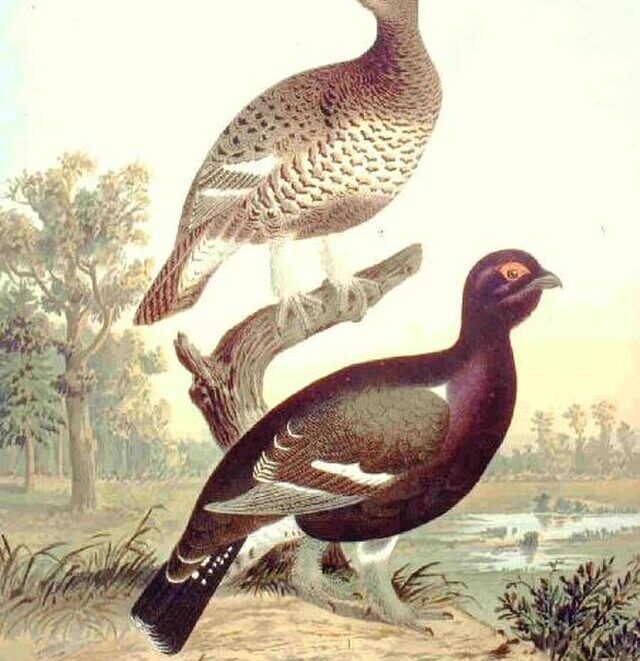
The grouse arrive with throaty cries, backs speckled brown and white with arrowed tails, orange crowns, and splashes of purple wobbling on the sides of their throats as they sing. They bob their heads and cross the grass with full-bodied struts.
Cramped in the hide, Alana’s hips ache from being pressed to the wood, her back from leaning upright. Elijah takes photos in bursts, as if every moment of the lek will be an important keepsake. Alana only takes photos when she remembers, when she’s more focused on remembering than paying attention right now. Even when she takes photos, she knows she’ll probably never look at them again. Sometimes she deludes herself into thinking that when Isobel is eight or twelve or fifteen, they’ll sit together on the couch and Isobel will be interested enough to look through them. Dozens of washed-out photos of birds in a sepia field.
They watch the display for hours. It goes like this: two grouse approach each other, circle each other. They spread their wings, the tips rounded toward the ground, and they begin to spin, rattling their upright rails. Sometimes, they fight, clipping the other’s torso or head with their talons. It’s the best two hours she’s had in a long time, even though her bones hurt. She matters less than these birds, and that’s what makes it so good.
She doesn’t know why she’s so unhappy. Not in this moment, but outside of this moment. Her life feels like an ibuprofen-smothered ache, like anxiety behind the meds. Everything should be pink and working. She has a healthy daughter. She has a cup of mint photosynthesizing on her windowsill. She takes vitamins, has rosy cheeks, has waist-length hair. Apparently she looks young for her age, says her neighbour, and it’s supposed to be a compliment.
“They’re called fire birds,” she whispers. Elijah pulls away from the peep. “Sharp-tailed grouse. They’re also called fire birds.”
“I didn’t know that.”
“You know why?” She wants to tell him something he doesn’t know, be right for once, be the prophet or the scholar and tell him something more interesting than turning water bottles into socks and stealing a poplar from their university quad. “It’s because they require brush fires to live. They need open habits. Isn’t that strange?” A bird whines, and for a moment she thinks it’s her daughter crying. Her heart kicks at her throat.
“Why would it be strange?”
“Because fires destroy everything else, but they’ve evolved to depend on them.”
“They’re just birds, Alana.”
They could be in that backyard again, a second chance at that same moment. She’d just wanted to make a wish, a pretty one that could float between them like an iridescent soap bubble. They could pop it and smile through the splatter. They could make the wish together, for each other. Health and happiness and easy final exams. Good summer internships and cheap plane tickets. The stars tell her who they are, but where can she read who she would have been if she’d won the snap? She knows only this: sometimes you let someone into your life despite knowing that one day they’ll hurt you. Sometimes you let that person in because you know they will.
Alana can’t move, or she’ll fall out of the hide. She chews her thumbnail, then tries to hide the bad habit by balling her hand, even though he definitely noticed. A child’s habit. Her mother used to dip her fingers into jalapeno brine to deter her. It only gave her an unnatural tolerance for heat. “Do you think they think about that?”
“The birds? They’re birds.”
“The ecosystem has to burn for them to thrive. Other things live there, too.”
“They definitely don’t think about that.”
“It just seems unfair to me.”
“It’s not unfair. It’s just nature.”
She can’t really argue with that.
He leans forward, sits up tall. She mirrors him, like a mockingbird.
“Here,” he lifts the camera from her lap, frees the strap from around her neck, and places it in the scratchy grass. She hugs her knees. Their shins press together. He fiddles with her jacket drawstring. Tugs, and her jacket hood scrunches. “It’s one of those things that’s just inevitable,” he says. And she supposes, that seems about true. She can’t argue with that.
She’s not sure who leans toward who. One of them does, and it’ll be easier tomorrow if it’s not her. She realizes with surprise, when the heat of his breath finds hers, that this is the first time they’ve ever kissed. The roommate had thought they’d been sleeping together. She means to pull back, because if she does now it can be something she lies about until she forgets, but she laces their fingers on the hide floor. It’s been so long since she’s decided anything that she’s not sure she remembers how. His other hand knits up the back of her skull and into the base of her braid. She can’t decide whose fault she wants this to be. Right before they’d snapped that carrot, she’d practiced how she was going to pronounce the words, how she’d let them fall off her tongue like a dare, like an accident. Kiss me. I dare you to kiss me.
His hands close around her waist and he pulls her in, first like a question, then an insistence. She hooks her knees over his hipbones.
She’s known this would happen. She’s known since wishbone. Inevitable. Potential energy. A match sleeping with its face against the striking surface. He unbuttons her shirt from the bottom up, toward her throat. The sleeves snag on her elbows when she tries to shrug it off. She could mention Ross, but she doesn’t. Cold goosefleshes her torso, like she’s stepped into a ghost. He slips his shirt over his head and her hands fit into the swoop of his shoulder blades. Maybe he’ll see her wedding ring, or feel its cold bite on the back of his neck. Her back slides across the splintery wood, spine notching to the planks. He folds his fingers under the waist of her jeans and pushes the denim down her hips. She could say she’s married. She could say it right now. Instead, she listens to a heart beating. Feathers rustle on the other side of the blind. Maybe he’ll see the scar from her C-section, but her chest is caged under his chest, and his hip bone crushes into her waist, and he doesn’t. She is either gaining control or losing it. Holding her breath for a different reason depending on the answer. Maybe she should have another baby. When she gets home, she’ll tell Ross she wants to have another baby.
To Elijah, she doesn’t have a daughter, and she doesn’t have a husband, and not because she never told him. It’s because she never grew up. She is still twenty-one and in a backyard eating mint leaves and doing shots of fireball. She is still baking pot brownies for his friends and tenderly carving an A into his arm. She is still sitting on her dorm room bed, and he’s sitting on the other side. She bumped their fingertips, then wefted their knuckles together. They held hands, that was all. A neighbour is going to tell her roommate he was there, and the roommate is going to think they had sex.
His breath frays against her ear. The air in her lungs feels solid. This is not like sex with Ross, dreamy and slow and safe. Habitual. Once a week on the duvet they’ve had for four years. In his neck, she no longer finds a scent distinct to him, but a woven-togetherness of them both that blankets their entire house. Elijah thumbs the vein in her wrist. It’s strangely reminiscent of but also nothing like the way she’d imagined what sex with Elijah would be when she was in college, that her fears and her body would thaw under his gaze and hands.
His scar is faded and pale, smoothed out. It has no distinct shape. It could be a scrape from a biking accident or a knife fight, depending on who he’s telling the story to. Her own scar is still jagged and maroon, the lines raised. People always ask, “What does the E stand for?” Ross saw it the first time they’d slept together, stopped her half-clothed.
“It was just some stupid thing my friend did at a party once,” she said.
“Someone did that to you?”
“It’s fine. I let him.”
“My god Alana. That looks like it hurt.”
“Not really.” It had hurt, she just didn’t want to talk about it, because the real story—wishbone carrot and Elijah passed out in the bathtub and an empty bottle of acetaminophen returned to the cabinet—made her feel at fault and so, so stupid. It had hurt, but it hadn’t hurt more than she’d needed him right then. If anything, it had fulfilled a kind of obligation; it had hurt the amount she figured was necessary for him to exist in her life.
She tilts her head back and looks up at the sky, a breath sticky in her throat that perhaps he interprets as pleasure. Grouse chant and scratch on the other side of the blind. There had been a lot of sounds on the other side of the wall, at that party. He’d dug the blade into her muscle. She’d only given him a scratch. She gave him both the painkillers. They don’t match, like he said was the point. Wasn’t this supposed to be permanent, that some piece of each other would be in the bed of every lover they ever had, and in whatever graves they finally settled in?
She used to believe in the stars because they told her who to be, made choices for her. She’s always known that someday she’d be here, with a bead of his sweat melting to her brow. At the same time, she also used to wish she’d been adopted, her birthday unknown, so she could be anyone she wanted to be. Unrestrained by the stars. A free agent in this world.
Soon, he’ll drive her home. It will take five hours. Her clothes will be recently buttoned shut. Alana has no idea what they’ll talk about. Maybe she’ll flick through her photos and they won’t speak at all. Maybe he’ll ask her if she still gardens, because he’ll try to act like he remembers who she is. He has no idea who she is. Maybe she’ll subtly slip her wedding ring into her pocket, or maybe she’ll fold her hands in her lap in just the right way to show it off. Maybe she’ll tug her jacket tighter around her shoulders and feel a splinter wedged into her back. Maybe she’ll tell him about it, but maybe she won’t.