Hello readers!
Just in time for autumn, I am pleased to introduce you to the runner-up of the 2026 Jacob Zilber Prize for Short Fiction: “Trespasses” by Matt Hawkins. This speculative piece, equal parts hilarious and monstrous, will keep you glued to the screen. I hope you all enjoy reading this story as much as I did!
Sincerely,
Megan Horsthuis
Promotions Editor
Trespasses
Of all of us four boys in our draughty student house, Frederick was the most responsible. Frederick did the weekly shop, keeping the bill at exactly £12.50 per head and allowing a twelve-pack of blueberry yoghurt as our sole indulgence for the week. Frederick managed the cooking rota, collected the money for our bills, and reprimanded us when we left the clippings of our fledgling beards in the bathroom sink. Every Tuesday — bolognese night — Frederick would first brown the mince, then decant the melted fat into an empty pesto jar so as not to clog the pipes.
I was the second most responsible. I put my empty bottles in the recycling and usually remembered to use the extractor when showering, but the one time I did the shopping (Frederick had the flu), the bill came to over £13 per head. Frederick looked at me as though I were a clock telling an impossible time — the same way he’d look if you ever called him Fred — and that was the last time I did the shopping.
The third most responsible was Brian. Brian had a girlfriend, so we never saw Brian. I couldn’t really say how responsible Brian was, on account of his constant absence, but it would be unfair to rank him beneath Sam for lack of data.
Sam was the fourth most responsible. Sam and Brian had been best friends, but since Brian was never around and Sam missed his friend, Sam acted out by eating more than his share of the blueberry yoghurt and shirking his washing-up duties. When Sam showered, which was rarely, he wouldn’t use the extractor, and Frederick would lecture him about damp and mould with his glasses all steamed up.
Sam, Brian and I had lived on the same corridor during our first year at Durham. Frederick had not been part of our group, but when it came time to find a house for our second year, we wanted a fourth housemate to spread the cost. I usually sat next to Frederick in maths lectures — more by habit than camaraderie — and since he had no other friends to live with, I suggested he come and live with us.
I soon came to regret this. As I learned later, Frederick had won many maths olympiads in his school days, but an acute algebraic panic — from which he had not recovered — caused him to miss the grades for his Oxford offer. Some nights, I would hear him cry out absurd proofs in his sleep, and in the morning I would find stacks of paper in the crisper drawer, scrawled with meaningless sequences of Greek letters. Whenever Frederick received an unsatisfactory grade, his domestic anality would intensify, and we would find post-its all over the house rebuking us for improper waste triage, or lambasting our neglect of the toilet brush.
Yet Frederick would not throw away the jars of beef fat. Instead he stacked them neatly on the kitchen windowsill, so he could later convert the fat to bird suet while benefitting from economies of scale. Since the latch was broken and the window would not close, the draught kept the fat cool, and because the window overlooked a shaded alley, there was no sunlight to spoil the fat. But the fat smelled regardless, and the draught carried its lipid stench through the house, where it commingled with Sam’s body odour and found its way into my wardrobe.
Living with someone like Frederick, one learns not only to pick battles, but that there is simply no battle worth entering. It galled me to find the grease-stench on my clothes every morning, and to notice girls giving me a wider birth than usual. Yet to challenge Frederick on the fat jars, or to throw them away, would have been to risk an attritional war of post-its that I could not win.
I had given up church in my mid-teens, but faced with this intolerable stalemate, I had no recourse but prayer. My devotions were rusty at first, and I kept muddling that line about trespasses, but I soon found my stride. I prayed for Frederick’s pen to run dry, and for the glue of his post-its to fail. I prayed that the grease-stench would waft out the window and spare my sweaters and shirts. Most of all, I prayed that Frederick would overcome his neuroses, and let me live and get laid like an ordinary student.
The fat jars may have been the worst creation in our kitchen, but Sam’s sausages were a close second. Every Wednesday, Sam served charred budget bangers and lumpen potato-slop, laced with an incongruous mix of spices. Sitting on the sofa with our plates on our laps, it was almost impossible to cut through the sausages without chunks flying across the room.
When Sam looked up from his plate one Wednesday and gaped at the doorway, I assumed his eyes were following one such projectile.
“Brian?” he shouted, in a pitch so high that he blushed. A second later, the colour drained from his cheeks and he put a hand over his mouth.
Frederick and I looked up at the figure in the doorway. It was not Brian, but a vaguely humanoid thing, cobbled together from lumps of congealed fat. Its head — or what could have been a head — teetered awkwardly over what seemed to be a shoulder. It had no face, but there was an opening on the front of its hairless pseudo-head that might have passed for a mouth.
I spat out a chunk of mash as the thing jiggled into the room with a squelching, lopsided gait, trailing grease on the carpet behind it. It stopped in front of Frederick, who leaned away and let his plate slide from his lap. His remaining one-and-a-half sausages rolled across the floor and stopped a few inches from the thing’s trotter-like feet.
There was a boggy suck from an armpit-like recess as the thing raised a kind of lard-arm towards Frederick.
“Brian?” Sam said again, weakly. He was clutching his knees to his chest and had mash and ketchup all over his t-shirt.
The thing gave a beckoning flick with its lard-arm, then it did something with its sort-of-mouth-thing: a kind of pop-squelch, like the cleaving of a watermelon. This seemed to snap Frederick out of his fear. Then the thing wriggled its arm again and Frederick took its hand — although it wasn’t a hand, exactly; more of a buttery stump — and followed the thing into his bedroom.
I will never know what went on in that room, but as soon as the door closed there arose a tremendous clamour: it was all hollers and pop-squelches; Eurekas and Hallelujahs; greasy slime-licks and gassy belch-clucks. Sam buried his face in the gap between the sofa cushions while I hesitated at Frederick’s door. I tried to parse the sounds. Frederick’s ecstatic whooping reminded me vaguely of that first week after Brian met his girlfriend, but without the moaning and rhythmic thumping. It seemed best not to interrupt.
This went on for ten hours. Frederick’s room was on the first floor, along with the kitchen and living room, and I bore the brunt since my room was directly below. There was no hope of sleep, but what could I do? Tell my intransigent housemate and the fat-monster to keep it down? Peace came, finally, around 6AM, when I heard Frederick rush down the hall and leave the house.
In the morning, the fat jars were as we’d left them — stacked on the windowsill, full of their solidified beige gloop as though nothing had happened. If it hadn’t been for the trail of grease on the floor, I might have written off the previous night as a dream, or some nutmeg-induced hallucination. The jars, I noticed on second glance, had a certain divine aura about them: a self-satisfied glow that bespoke wisdom and the eternal. And the kitchen smelled not of grease, but of vanilla and freshly-mown meadows. Sparrows and blue tits perched outside the window singing fluty arias and major-key arpeggios, and I thought to myself, this is really nice.
Usually Frederick and I would walk to our Thursday morning lecture together, but since he was already out, I did the half-hour walk alone. When I arrived, some other students were milling about outside the lecture hall. The door was closed, with a blu-tacked note saying that Due to unforeseen circumstances, Dr. Swan’s 10AM lecture has been cancelled.
I looked about for Frederick, but couldn’t see him, so I went home. I found Frederick on the living room sofa, eating a pot of blueberry yoghurt while watching the morning news. He didn’t look up.
I didn’t know how to bring up the topic of the previous night, so we sat quietly for a minute until Frederick licked the film of his yoghurt and said “I suppose you’re wondering what happened last night,” and I said “Yes.”
Frederick told me he was wondering the same thing. He couldn’t remember specifics; all he knew was that, via some wobbly, squelching inducement, the thing had helped him to overcome his horror of matrix multiplication. He was thus able to formulate a new tensor paradigm, which brought with it the long-sought proof that ω = 2. All of this was beyond my comprehension, but when Frederick cornered Dr. Swan an hour before the lecture to show him his notes, the implications for linear algebra were so massive that the poor old academic fainted and had to be admitted for observation.
Over the next few weeks, it kept happening the same way. We would be eating dinner in the living room, and the thing would appear at the doorway. Sam would go pale and say “Brian?” in that same weak voice, and I would say “No, Sam; surely you remember?” and Sam would clutch his knees to his chest, forgetting about the meal on his lap and getting ketchup or mash or pesto all over his t-shirt. Then the thing would approach Frederick, hold out its lard-arm and make that pop-squelch with its sort-of-mouth-thing, and Frederick would follow it out of the room, whooping and hollering into the small hours, then rushing out of the house before sunrise.
Frederick made a raft of further discoveries. He proved the Riemann Hypothesis, devised an incontestable system of axioms for set theory, and showed that there is, in fact, a final digit of π (it is 4). Before long, he was the subject of press conferences, broadsheet editorials and satirical skewerings on comedy panel shows — and here he was on our sofa, eating blueberry yoghurt.
And this, now, was all he ever did. Besides the frantic nights with the fat-monster, the only thing he could find the energy for was yoghurt. Whether it was the mental exertion of his discoveries or the stress of celebrity status, he seemed perpetually exhausted, with his cheeks blooming with acne and his hair falling out in clumps. He no longer seemed to care about the extractor or the particulars of waste disposal, and his post-it campaign petered out. He even began to tolerate people calling him Fred. His demeanour was so indifferent that Sam and I didn’t even mind him taking liberties with the yoghurt; it seemed a fair concession to make to a generation-defining mathematician.
Durham is small, so Frederick’s address soon became common knowledge. Whenever a hopeful admirer knocked on our front door, Sam would look up excitedly and say “Brian?”, and I would remind him that Brian had a key, so if it were Brian there would be no knock. Frederick was bored by the attention, so I was always the one who answered. One time I opened the door to a boisterous Argentinian couple who had flown twenty hours to pay homage to ¡Federico! They brought with them a pastry cake with dulce de leche oozing from the sides — a bulbous, sweaty caramel that reminded me of the thing. I didn’t let them in, but they kept bowing at me (they seemed to think I was ¡Federico!), and they insisted that I accept the cake. I thanked them and put it in the bin.
Every time the thing appeared, I would have to mop its trail of slime from the kitchen floor while Frederick cavorted in his bedroom. I always knew what would follow: another discovery, further hysteria, more admirers and offerings at the door, while Frederick rotted on the sofa. But I never considered discarding the jars, because things were better now. Sam, who had nothing to rebel against without Frederick on his case, now showered daily and used the extractor, sending the black mould into retreat. Frederick of course never came on nights out, but girls who would once have been out of my league now invited me home from airless dance floors because they recognised me as Frederick’s friend.
I felt bad for Frederick — as tiresome as he was before this all started, I sometimes missed the jeopardy of his post-its and the comedy of his quirks. He was now a mere husk, existing only to devour yoghurt and make academics tremble in their loafers. I might have prayed for him, if I had known what to ask for, and if my days hadn’t been so filled with birdsong and casual sex. I am ashamed to say it now, but it was easier to live with him this way.
One evening in February, when we had the TV turned up to drown out the chants of Frederick’s devotees, Sam caught sight of something out the window and straightened up on the sofa.
“Brian!” he shouted. He stood and pressed his forehead to the window.
“Sam…” I said, “sit down.”
Sam’s breath steamed the window. “BrianBrianBrian!”
I got up and peered over Sam’s shoulder. Sure enough, Brian was walking sadly up the hill with his hands thrust in his coat pockets.
“BrianBrianBrian!” Sam bounced on his toes and his forehead thumped against the window, but Brian didn’t look up. The crowd outside was singing an ode to Frederick to the tune of O Come, All Ye Faithful.
“BrianBrianBrianBrian!” The floor shook with Sam’s bouncing. Brian, seeing the crowd at the front door, went through the side gate and down the alley. Sam ran to the kitchen and carried on shouting, while Frederick watched blankly from the armchair.
I could no longer see Brian, but Sam was at the kitchen window, bouncing and shouting just the same. His head knocked against the unlatched window and it flung open.
“BrianBrianBrianBrianBrian!” Sam thrust out his backside as he leapt higher and higher with his hands planted on the windowsill. Then his foot landed on an unmopped patch of grease and he slipped, knocking the jars out the window.
The jars smashed in the alley and Brian shouted “Fuck!”. I went to the window and looked down. Brian was fine, but the alley was strewn with glass and blubber. Brian stared at it in revulsion then looked up at me. He looked like he had been crying.
When the lumps of fat began to coalesce and form into the thing, Brian shouted “Fuck!” again and ran in through the side door. “FuckFuckFuck!”, he shouted as he crashed through the hall and up the stairs.
The thing squelched about the alley, knocking over bins and bumping into walls. At first I thought Brian must have startled it, but then I heard the first PEEP-TRILLLLLLs and saw the tiny shadows collecting on the roof gutters. They chirped and whistled in a frenzy — first dozens, then hundreds of them — sweeping into the alley one-by-one, nipping at the thing as it whirled about in a blind panic and hissed raspberries through its sort-of-mouth-thing. It batted at the birds with its lard-arm, stunning a blue tit and sliming a jay, but a pair of chiffchaffs got into its folds and pecked devastatingly at its unmentionables.
Bigger birds arrived. First a buzzard swooping KEE-YAA into the alley, then a cast of peregrines diving and punching their bills at the thing’s neck, crowing AAAAH AHH AAAH as the thing hobbled towards the gate.
The commotion roused Frederick into the kitchen. Seeing that the jars had gone, he came to the window and nudged me aside. I could barely see the thing now — the alley was a swarming roll call of avian species, both local and far-flung: starlings tussled with waxwings for real estate on the thing’s back, while a kestrel picked off little wrens to make way for its long tail.
The thing made it through the gate and out of view, and the din of the birds grew at once more distant and more haunting as it was joined by human shrieks. Frederick ran barefoot down the stairs and out the side door while the terrified people in the street thumped on our front door and tried to get in. The last I saw of Frederick was his skinny heels as he disappeared through the gate, following the thing down the hill towards town.
Three days later they found Frederick in the Wear, trapped under a fatberg at the base of Elvet bridge. I had prayed for him on the first and second nights, but I already knew it was too late and my prayers felt disingenuous. After a week or two, people stopped leaving flowers at our door, and girls began avoiding me again on account of my proximity to death. For the rest of that year, Sam and Brian hugged each other a lot. I lost touch with them after university, but I think they are married now. I think they are happy. I’d like to talk to them, but they’ve moved on. I’d like to talk about how I keep seeing Frederick’s face on leaflets from the water company, reminding people not to rinse oil and fat down the sink. I’d like to talk to them about this. I don’t know why I find it funny.
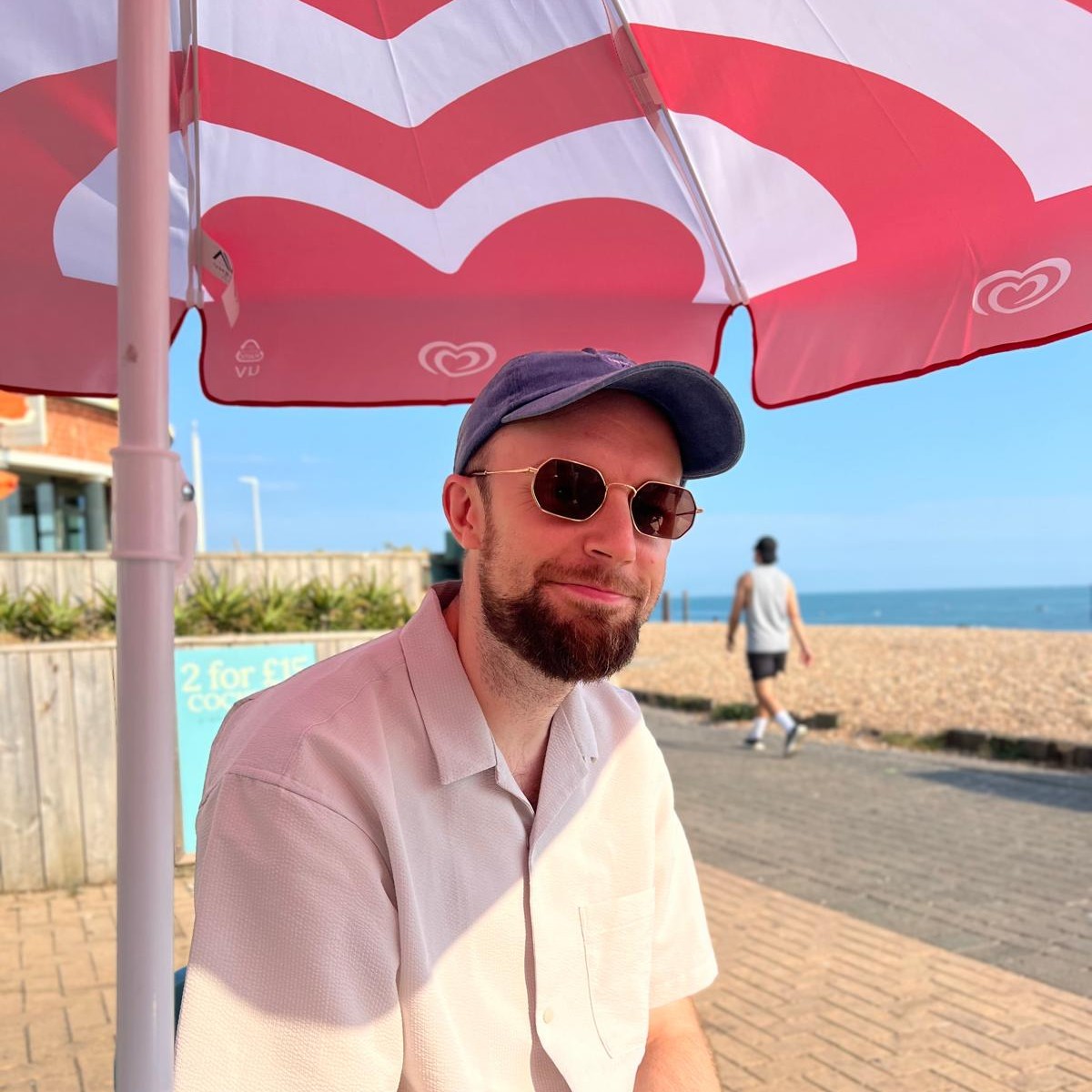
Matt Hawkins is a British writer living in London. He holds a degree in Modern Languages from the University of Durham, where he and his housemates amassed a troubling collection of fat jars.