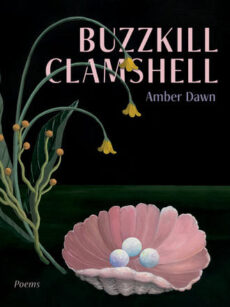
Buzzkill Clamshell
Amber Dawn
Arsenal Pulp Press
Review by Margo LaPierre
Pain can limit us. A bed can be a constraint. But in Amber Dawn’s third solo collection of poetry and eighth book with Arsenal Pulp Press, constraint elevates and intensifies.
Buzzkill Clamshell opens its first poem, “The Erotics of Chronic Pain,” with an old wives’ tale lifted from The Old Farmer’s Almanac involving whippoorwills and an improbable dance of circularity. Birds flit, dive, and bleed across the pages of Buzzkill Clamshell, lending the collection mythic, folkloric vibes. It becomes clear that relief from pain is synonymous with death in these poems that are often macabre, yet lively, and fully engaged with a resignification of the body’s dizzying hurts. These are poems in which chronic pain and disability are foundational, though subject to subversion nonetheless. Pain makes real the conceptual while wilding the real. With the right context, pain can be turned into dazzling, transformative pleasure. Amber Dawn asks, “Why can’t change be as graceful as the volta in the poem?” But we learn that the grotesque has an aesthetic all its own, seditious and freakish. “To endure beyond the empire is poetry, / it’s a lavish axe.” Endurance is liberation, a creative act.
The collection is deeply enriched by its political bent. A standout for me was the expansive, anthemic, dreamlike poem “Safe Space: A Monosyllabic Rewrite of Ann Cvetkovich’s An Archive of Feelings.” Speaking of queer theorists, I like to think that Eve Kosofsky Sedgwick would’ve found this whole tactile, moody collection brilliant. The poem “Hostile Architecture,” too, with its attention to spaces that deny safety and bodily ease.
Amber Dawn’s language throughout is that of play: sound play, word play, kink, hot syllables, and an active, ludic tongue delighting in slants and round vowels. In “Lewis Carroll Could Never,” a nonsense poem, she writes, “c’mere chimera moonbait bouf untouched woo / woo swoop oofable as an angora rabbit / and she bites if startled she has a mind like fallow / wheat and might like a good thundering.” Humour riddles the abjection; I did a double-take then giggled at the clever take on the TikTok meme “She’s a 10, but …” in the poem “Age Play”: “Pain scale red is a colour. I’m a ten, but / my medication causes memory loss.” Readers with their own extensive medical histories may recognize the anxiety-inducing language of questionnaires in the speculative poem “YOUR PARTICIPATION IS VOLUNTARY,” which blurs the border of truth and fiction and calls into question the validity of consent in response to confusing medical language. There are memoiristic touches, though far less of that mode than in her previous collection, My Art Is Killing Me. Notice self-aware glinty-eyed sass with lines like “I’ll never write the word trauma in a poem again.” There it is on the page, its meaning as recursive as trauma itself.
What’s clear to this reader is how much fun Amber Dawn is having with the medium. While formally rigorous—with a return to the glosa form of her poetic debut, Where the Words End and My Body Begins, as well as haibun, ghazal, a superbly sinister unrhymed villanelle, and a number of ancient Italian forms—the poems are saucy and filled with the unexpected. As Amber Dawn declares in an ekphrastic poem inspired by Henry Fuseli’s heavy-on-the-chiaroscuro painting Titania and Bottom (1790), “If not friendly, at least fun. What kind of fun? Depraved, I hope.”
If you enjoyed Hannah Green’s Xanax Cowboy, Melissa Febos’s Body Work, Leah Lakshmi Piepzna-Samarasinha’s Care Work, or Catherine Hernandez’s Crosshairs, you’ll want to read Buzzkill Clamshell. Fans of Amber Dawn’s earlier fiction and poetry may notice a shift from spectral entities to more visceral ones: teeth, guts, and growths. Horror film and TV references abound. Cum is chaos magic, divination, ritual. At a time when queer, trans, and disabled bodies are endangered by policy that attempts to render them monstrous and deviant, Amber Dawn offers a safe space that is challenging, formally intricate, and audacious. Its end note is one of hope, of renewal, and of future-facing queer and disabled community.
________________________________________________________________________________________________________________
Margo LaPierre is a writer and freelance literary editor. With multi-genre work published in The Ex-Puritan, CV2, and Room, among others, she has won national awards for her poetry, fiction, and editing. She has served on Arc Poetry’s editorial and executive boards since 2019 and holds an MFA in Creative Writing from UBC. Her second poetry collection, Ajar, an exuberant account of bipolar disorder that goes beyond the binary, is forthcoming with Guernica Editions this fall.