Review by Taryn Grant To the Back Of Beyond by Peter Stamm, translated by Michael Hoffman Other Press, 2017 At first pass the title reads with a satisfying punch and clarity: To the Back of Beyond. On further scrutiny,...
Raina von Waldenburg’s play 12 Minute Madness starts simply: a janitor sweeps the bare stage before the MC, one face of protagonist Marlena von Twattenburg, makes introductions. It’s a gentle introduction to a show that very quickly, and with...
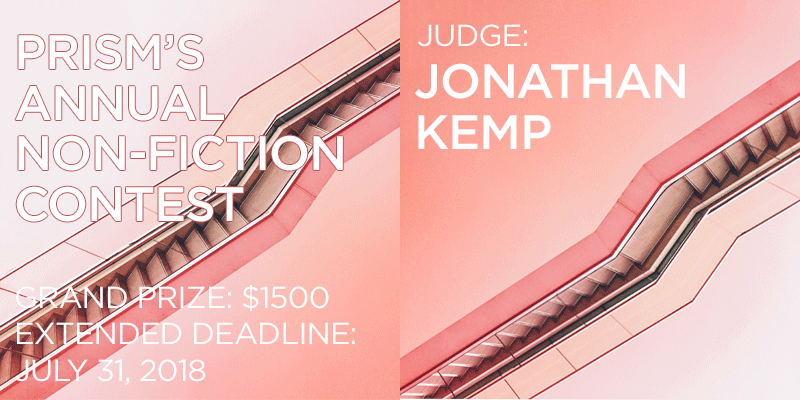
We are happy to announce that our annual PRISM international Non-Fiction Contest is now open for submissions. We are absolutely delighted to introduce our judge from across the pond: Jonathan Kemp! Jonathan Kemp’s debut novel London Triptych (Myriad, 2010) was acclaimed...
Hello friends! Meet Casey Plett, author of Little Fish and A Safe Girl to Love and co-editor of the anthology Meanwhile, Elsewhere: Science Fiction and Fantasy from Transgender Writers. She is the winner of the Lambda Literary Award for Best Transgender Fiction and received an Honour of Distinction from The Writers’ Trust of Canada’s Dayne Ogilvie Prize for LGBTQ Emerging Writers.
During my volunteer role at Room Magazine’s 2018 Growing Room Literary Festival, I had the great pleasure of hearing Casey read from Little Fish and getting to know her in-between events. In addition to admiring her work and discussion during the panels, Casey’s behind-the-scenes demeanor was something that has stayed with me. She offered a kind of warmth, humorous levity, and generosity to the volunteers and audience members that I think goes above and beyond the expectations of writers at events, especially during a time where authors and volunteers alike are stressed, exhausted, and usually running on fumes. It is something that usually flies under the radar to the comparatively large-scale attention given to readings and panels, but one I think is important. Yesterday, I started reading Little Fish. And already the humour, care, and depth that I saw during that weekend, I’m finding everywhere in her storytelling. If you get the opportunity, get this book and go hear her read. It’s so damn worth it.
Former PRISM poetry editor Rob Taylor sat down with poet, author and former journey carpenter Kate Braid to discuss her newly released poetry collection “Elemental” (Caitlin Press, 2018).
I spoke with you briefly for PRISM international back in 2014, and at that point you noted: “Looking over my recent poems, I’m a bit alarmed to find I’m writing more personally, neither behind the mask of another or out of my experience as a carpenter – which also became a sort of persona.” True to that statement, Elemental, though certainly structured around “elemental” themes, feels in other ways like your first “general” collection (your past collections having channeled Glenn Gould and Emily Carr, among others). In that sense it feels almost like you’re living the traditional poet’s trajectory in reverse (the early, more personal/general collection, followed by themed “projects”). Do you think of this book in those terms (“general” and personal), and do you think it represents a larger shift in your preoccupations/energies as a writer? Did “removing the masks” allow you to access some more “elemental” part of yourself?
Sarah Selecky is a vegan, a Virgo, and a lover of dark chocolate. But she’s more well-known for her writing and her teaching. The New York Times called her first book, This Cake Is for the Party, “utterly fascinating.” This collection of short stories was a finalist for the Scotiabank Giller Prize and the Commonwealth Prize for Best First Book in Canada and the Caribbean, and was longlisted for the Frank O’Connor Prize. Her writing has appeared in The Walrus, The New Quarterly, and The Journey Prize Anthology. Through Sarah Selecky Writing School, she runs online creative writing and mentorship programs, and an annual international writing contest. Her new novel Radiant Shimmering Light will be published by Harper Collins Canada in May 2018.
Our “BAD” themed issue will be on stands soon, and includes work by some of Canada’s most talented and thought-provoking emerging writers. This issue is an invitation to reconsider our biases and values, and to test the limits of...
Trees are blooming, birds are singing and the new editorial team for PRISM international has arrived! We will miss our departing editors and would like to thank Kyla, Selina and Shazia for doing such an amazing job! Jessica has...
Our newest issue 56.3 “Bad” is finally out and full of beautiful content! Get your own issue now! Contents THE PACIFIC SPIRIT POETRY PRIZE Judge’s essay: Aisha Sasha John – On the 2017 Pacific Spirit Prize Winning Poems Poetry Grand Prize Winner Ashley Hynd – First Communion (1992)...